Many DeFi users assume that choosing a well-known wallet is the same as being safe. That’s a comforting shortcut, but it’s misleading. Security in DeFi is layered: smart contract bugs, malicious dApps, careless approvals, and user UI mistakes all conspire to make non-custodial wallets a risk surface, not a shield. The deeper question for power users is less “Which wallet is safe?” and more “Which wallet gives me the right tools to reduce avoidable, human-driven losses and to recover quickly when things go wrong?”
This article unpacks how a wallet like Rabby approaches those toolsets — transaction simulation, pre-transaction risk scanning, approval revocation, cross-chain gas top-ups, hardware and multi-sig integration — and contrasts those features against common alternatives. I’ll correct three common misconceptions, explain the mechanisms behind Rabby’s security-oriented features, compare trade-offs with MetaMask and Coinbase Wallet, and finish with decision heuristics a U.S.-based DeFi power user can reuse.
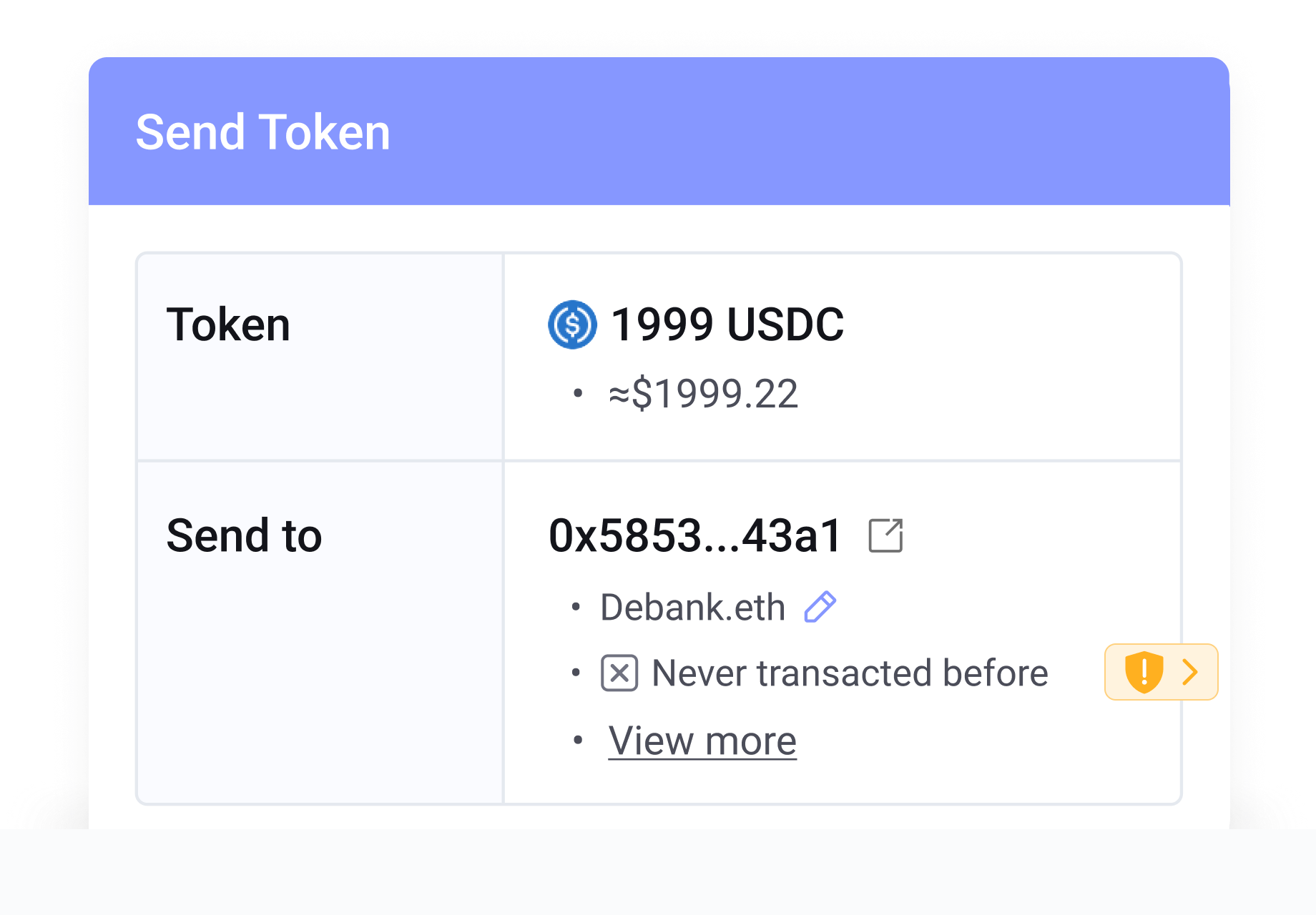
What Rabby actually does differently (mechanisms, not marketing)
Rabby is built around the premise that most losses come from bad decisions or blind signing, not from private keys being stolen on the desktop. Two mechanisms deserve attention.
First, pre-transaction risk scanning. Before you sign a transaction, Rabby runs an on-device engine that checks for red flags: whether the target contract has known exploit history, whether an approval request would give unlimited spending allowance, or whether the recipient address is nonsensical. Mechanistically this is a pattern-matching plus reputation check. It reduces the class of social-engineering and dApp‑maliciousness attacks by giving context you otherwise have to obtain from external tools.
Second, transaction simulation or “what-will-happen” preview. Rather than show you only the calldata and gas, Rabby executes the intended transaction in a local simulator against recent chain state and shows the estimated token balance deltas and fees. That’s not 100% predictive — state can change between simulation and mined transaction — but it addresses blind signing by translating opaque calldata into concrete financial consequences. For many common DeFi flows (swaps, approvals, liquidity moves) this simulation will expose surprising behavior: unexpected slippage, hidden fees, or implicit token transfers.
How those mechanisms change behavior — and where they fail
These features matter because humans respond to clearer information. When a wallet says “this approval will allow contract X to move unlimited tokens” and provides a one-click revoke tool, users are far more likely to revoke risky allowances. When a simulation shows that a swap will leave a tiny dust balance or cost more in fees than expected, users can pause and adjust slippage or route. That’s the real security gain: fewer mistakes and faster remediation.
But there are limits. Simulation depends on accurate node data and the assumption that the transaction environment remains stable between simulation and execution. Sandwich attacks, mempool front-running, or reentrancy bugs can still produce loss even after a clean simulation. Similarly, reputation-based risk scanning can only flag what is known: novel zero-day exploits, obfuscated malicious contracts, or attacker-controlled projects not yet flagged will slip through. Rabby’s open-source MIT license helps here — independent audits and community review can mitigate unknowns — but open code is not a substitute for formal correctness proofs or perfect foresight.
Finally, some practical constraints matter to U.S. users: Rabby currently does not offer a built-in fiat on-ramp, and it lacks native in-wallet staking. That means for buying crypto you still need a regulated on-ramp (Coinbase, Kraken, Ramp integrations outside the wallet) and for staking you must either use protocol-specific staking UIs or custody solutions. If your workflow demands on-ramps and integrated staking, Rabby will be only part of your stack rather than a one-stop product.
Comparing trade-offs: Rabby vs MetaMask vs Coinbase Wallet
When choosing among wallets, consider three axes: safety tooling, convenience features, and institutional integrations.
Safety tooling: Rabby emphasizes pre-transaction scanning, transaction simulation, and approval revocation built into the UI. MetaMask provides ubiquity and ecosystem compatibility but traditionally lacks integrated transaction simulation as a default; users rely on external tools. Coinbase Wallet focuses on consumer UX and fiat connectivity more than advanced security tooling. If your priority is transaction-level decision support, Rabby has the advantage.
Convenience: MetaMask remains the default for many dApps and has enormous third-party integration. Coinbase Wallet offers smooth fiat rails for U.S. retail users. Rabby trades a little convenience for better safety defaults: automatic network switching, a Flip toggle to swap as default with MetaMask, and cross-chain gas top-up to rescue wallets on networks where you ran out of gas. Those features reduce friction for multi-chain DeFi workflows, but you will still handle fiat off-ramps externally.
Institutional features: Rabby integrates with multi-sig and custody providers (Gnosis Safe, Fireblocks, Amber, Cobo), and supports many hardware wallets, which is critical for treasury or team setups. MetaMask has hardware compatibility as well but fewer enterprise connection points natively. Coinbase’s custody products are strong for on-ramps and custody, but its consumer wallet is less focused on multi-sig enterprise needs.
Choosing for your use case: a quick decision framework
Here are three heuristics to guide selection:
– If you are a high-frequency DeFi trader or active liquidity manager who signs many complex transactions: prioritize transaction simulation and approval controls. Rabby’s simulation reduces the “blind signing” risk and saves time reversing bad approvals.
– If regulatory-friendly fiat on‑ramps and easy credit/debit purchase are your needs (particularly for U.S. compliance workflows): pair Rabby with a regulated exchange for funding rather than expecting Rabby to provide direct fiat purchases.
– If you manage team funds, treasuries, or institutional flows: use Rabby alongside multi-sig custody (Gnosis Safe) and hardware wallets. Rabby’s integrations support those flows while preserving non-custodial control over keys for day-to-day dApp interactions.
Myth-busting: three common misconceptions
Misconception 1 — “Open-source means safe.” Correction: Open-source allows audits and community scrutiny, which are valuable, but safety requires continuous audits, good development hygiene, and responsible response procedures. Rabby’s MIT release and open code are necessary but not sufficient.
Misconception 2 — “A simulation guarantees you won’t be hacked.” Correction: Simulation reduces accidental misuse and clarifies outcomes, but it can’t prevent exploits originating in the smart contract layer or mempool manipulation. Simulations are about informed consent, not omnipotent protection.
Misconception 3 — “No fiat on‑ramp means a bad wallet.” Correction: Wallet design choices include specialization; Rabby prioritizes transaction security and multi-chain convenience over embedded fiat rails. For many power users this is preferable — it reduces attack surface and keeps custody clean — but it does mean an extra step when buying tokens in the U.S.
For a straightforward way to evaluate and install Rabby: if you want to try a security-first, multi-chain browser extension with simulation and revocation tools, see the official project page for downloads and platform choices: rabby wallet.
What to watch next (conditional scenarios)
Signal to monitor 1: improved on‑ramp partnerships. If Rabby integrates regulated fiat providers inside the wallet, that would change its position for U.S. retail users — increasing convenience but also raising regulatory and AML/KYC trade-offs.
Signal to monitor 2: broader formal verification and bounty outcomes. The stronger Rabby’s continuous security audits and bug-bounty program, the more its reputation for safety will be grounded in demonstrated vigilance rather than claims. Watch for published audit reports and bounty payouts.
Signal to monitor 3: multi-chain gas UX. Cross-chain gas top-up is already useful; further UX advances (e.g., automated sponsored gas or relayer models) could reduce friction for interacting with new L2s and sidechains, but they also introduce counterparty dependence and potential KYC requirements.
FAQ
Does Rabby’s transaction simulation stop front-running and sandwich attacks?
No. Simulation helps you understand stated outcomes against current chain state, but it does not prevent attacks that occur in the mempool or after your transaction is submitted. To reduce front-running risk you must combine simulation with gas-price management, private submission options (if available), and cautious slippage settings.
Can I use Rabby with a Ledger or Trezor hardware wallet?
Yes. Rabby supports many hardware wallets (Ledger, Trezor, Keystone, and others). Using a hardware device with Rabby preserves private key security while letting you use Rabby’s simulation and approval tools — a good blend of safety and functionality.
What happened in Rabby’s 2022 incident and should I be worried?
In 2022 a smart contract tied to Rabby Swap was exploited for roughly $190,000. The team froze the contract, compensated users, and increased audit efforts. The event is a reminder that non-custodial wallets interoperate with third-party contracts; wallet-level protections reduce certain risks but cannot immunize against every contract-level vulnerability.
Is Rabby suitable for institutional users?
Yes — Rabby integrates with Gnosis Safe, Fireblocks, and other custody solutions, and supports multi-sig workflows. For institutional use combine Rabby’s UI and simulation features with established custody practices and compliance controls.
Takeaway: for U.S. DeFi power users who sign complex, frequent transactions across many EVM chains, a wallet that prioritizes transaction simulation, approval control, hardware compatibility, and multi-sig integrations materially reduces avoidable risk. That does not mean Rabby or any wallet removes systemic risk — but it does change the attack surface from “blind trust” to “informed decisions,” and that difference matters when real money is at stake.